




EGYPT: Rashid Petroleum Plans to Double Gas Production by 2029/2030
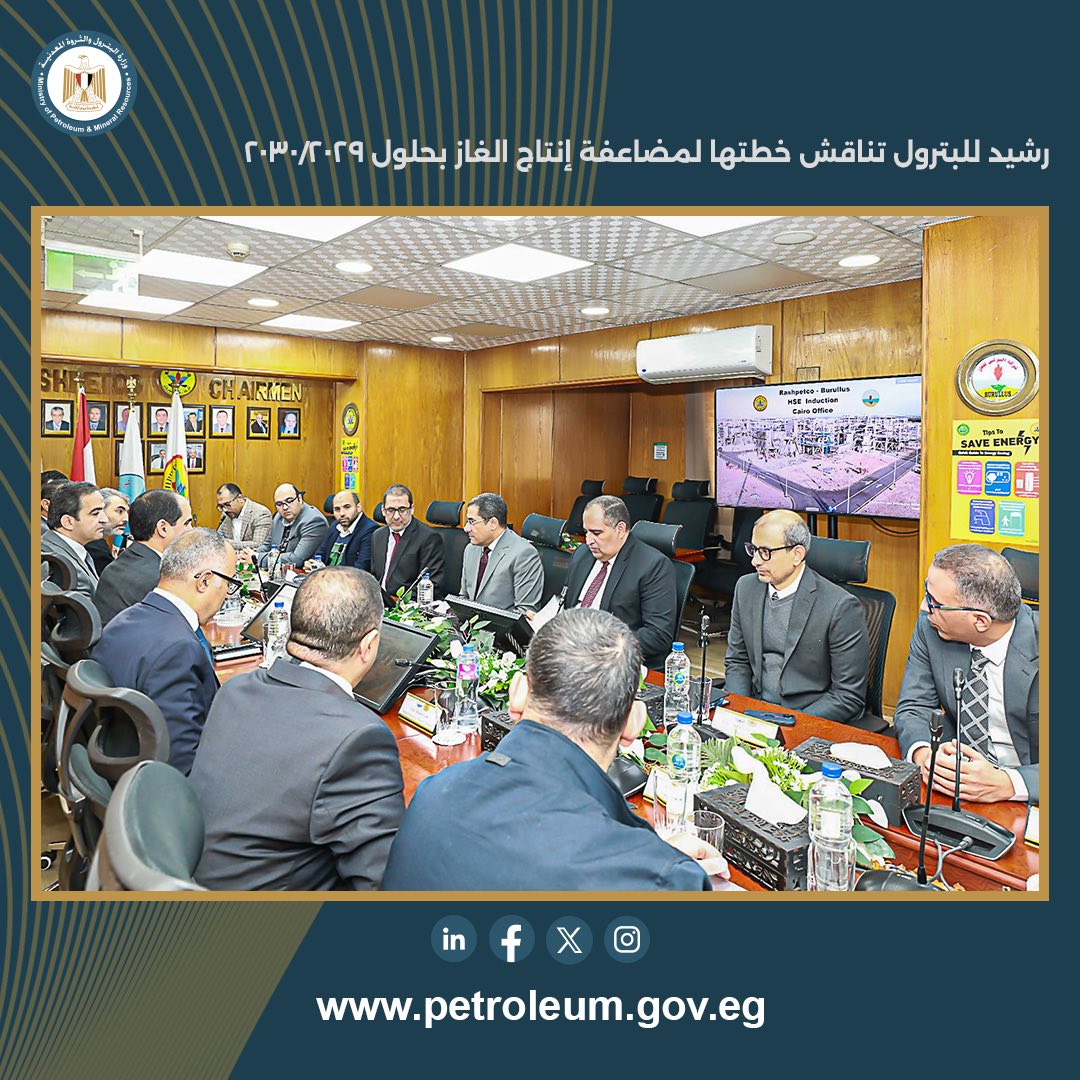
Rashid Petroleum Company held an expanded meeting to present the five-year plan (2025–2030) for the company and its affiliated companies, which include Burullus Gas Company and West Mena Gas Company, in the presence of Engineer Ehab Ragai, First Undersecretary of the Ministry of Petroleum and Mineral Resources for Production Affairs, and Dr. Samir Raslan, Undersecretary of the Ministry of Petroleum and Mineral Resources for Agreements and Exploration Affairs.
Engineer Sayed Selim, Chairman of the Company, and the team reviewed the five-year plan and its main objectives, which aim to reach gas production rates equivalent to double the current production by the fiscal year 2029-2030, through an ambitious vision to maximize the benefit from existing assets and infrastructure and inject new investments in cooperation with partners, which was emphasized by Engineer Khaled Gad, General Manager and Managing Director.
The presentation addressed the results of the four-dimensional (4D) survey project in the West Delta Deep Water and South Sequoia concession areas, in preparation for adding new possibilities to the reserve portfolio and supporting future production phases.
The production plan for the West Mena area wells was also reviewed, which includes drilling and completing new wells, with drilling operations starting next month, with an expected production of 160 million cubic feet of gas and 1,900 barrels of condensates by the fourth quarter of 2026, in addition to reviewing the promising exploration opportunity (Cyrus) and its development plan through the drilling of four wells.
The meeting included a presentation of the drilling plan for the twelfth development phase (12-A), which will begin implementation in the first quarter of 2027 with investments of $350 million, applying the same approach as the tenth and eleventh phases. This phase is expected to add 150 million cubic feet of gas per day and 2,700 barrels of condensates.The exploration plan for the deeper layers in the western Delta, Rosetta and southern Sequoia was reviewed, which includes six exploration possibilities, reviewing the estimates, expected success rates, technical risks and ways to reduce them.
The company’s efforts to increase production from existing wells through the reservoir and well management program and the return of some closed wells to production were reviewed, as well as the application of modern technologies to reduce costs and accelerate the development of projects.
The ministry’s leaders praised the results achieved and the company’s success in reducing drilling time in the tenth and eleventh phases thanks to the application of modern technologies and directional drilling, stressing the ministry’s support for all plans aimed at accelerating production and expanding the use of artificial intelligence and data analysis.